
Shift-work strain: what tires you out the most
Not every shift takes the same toll. We gathered the research on what tires shift workers the most, and how good scheduling lightens the load.

What makes shift work taxing
About a fifth of Finns work shifts and roughly one in ten does night work. The strain is not evenly spread: night work, short gaps between shifts and the sleep debt they cause tire people the most. Below are the essentials at a general level, based on publications by the Finnish Institute of Occupational Health (Työterveyslaitos). The exact recommendations and sources are in the links.
Circadian disruption and sleep debt
The heaviest strain comes from working when the body expects sleep. This disrupts the circadian rhythm and leads to sleep debt. According to the Finnish Institute of Occupational Health, being awake for a full day impairs performance in a similar way to a blood alcohol level of about one per mille. See FIOH: night work and health.
Short gaps between shifts (quick returns)
A gap under 11 hours, and especially under 8 hours, leaves too little time to sleep and recover. A typical example is a late evening shift followed straight by an early morning shift. The Finnish Institute of Occupational Health recommends avoiding weekly repetition of these quick returns. See recommendations for shift planning.
Several night shifts in a row
Consecutive night shifts build up sleep debt, because daytime sleep often stays short. Recovery is faster when only a few night shifts fall in a row. Research indicates that shift work with night shifts is most taxing precisely in demanding rotations.
Very early mornings and long shifts
Very early morning shifts cut night sleep short, and long shifts add fatigue towards the end of the shift. The Finnish Institute of Occupational Health recommends, for example, shift changes at 7 and 19 rather than the earlier 6 and 18, and adequate breaks in long shifts.
Long-term health risks
In demanding rotations, shift work with night shifts can raise the risk of cardiovascular disease, type 2 diabetes, breast cancer and work accidents. According to the Finnish Institute of Occupational Health, shift work raises the risk of heart attack by about 20 percent. See FIOH: shift work.
This guide is a plain-language summary and does not replace guidance from occupational health services or the Finnish Institute of Occupational Health. The figures and recommendations are based on its publications, which we link to.
How to lighten the load
Strain is not the inevitable price of shift work. Most of the levers are in the planner's hands: the same hours can be scheduled noticeably lighter.
Enough rest between shifts and across periods
The most important lever is leaving enough rest: at least an 11-hour daily rest and adequate weekly rest. Rest accumulated across the whole balancing period matters too, not just a single gap between shifts.
Taking employee wishes into account
When employees can influence their own shifts and their wishes are taken into account, strain eases and well-being improves. A say over your own working hours also reduces sick leave, research shows.
A forward-rotating shift system
A morning-evening-night rotation is easier on the body than a backward-rotating one, because it leaves more recovery time between shifts.
Fewer consecutive night shifts and quick returns
Keep the number of consecutive night shifts small and avoid gaps under 11 hours. That way sleep debt does not build up and recovery is faster.
Recovery time around evening and morning shifts
Adding recovery time around evening and morning shifts improved sleep, alertness and perceived health in studies. Working-hour strain can be assessed with the FIOH traffic-light model.
A shift planner's checklist
These checkpoints are based on the recommendations of the Finnish Institute of Occupational Health. When a roster meets them, most of the strain is already off.
At most 2–3 night shifts in a row, and at least two days off after a run of nights.
At least 11 hours of rest between every shift, also on changeover days.
Rotate shifts forward: morning, evening, night, not the other way round.
Start mornings at 7 rather than 6, and give long shifts proper breaks.
An unbroken weekly rest every week and free weekends at regular intervals.
Collect wishes before building the roster and record them where everyone can see.
How Smove lightens the load
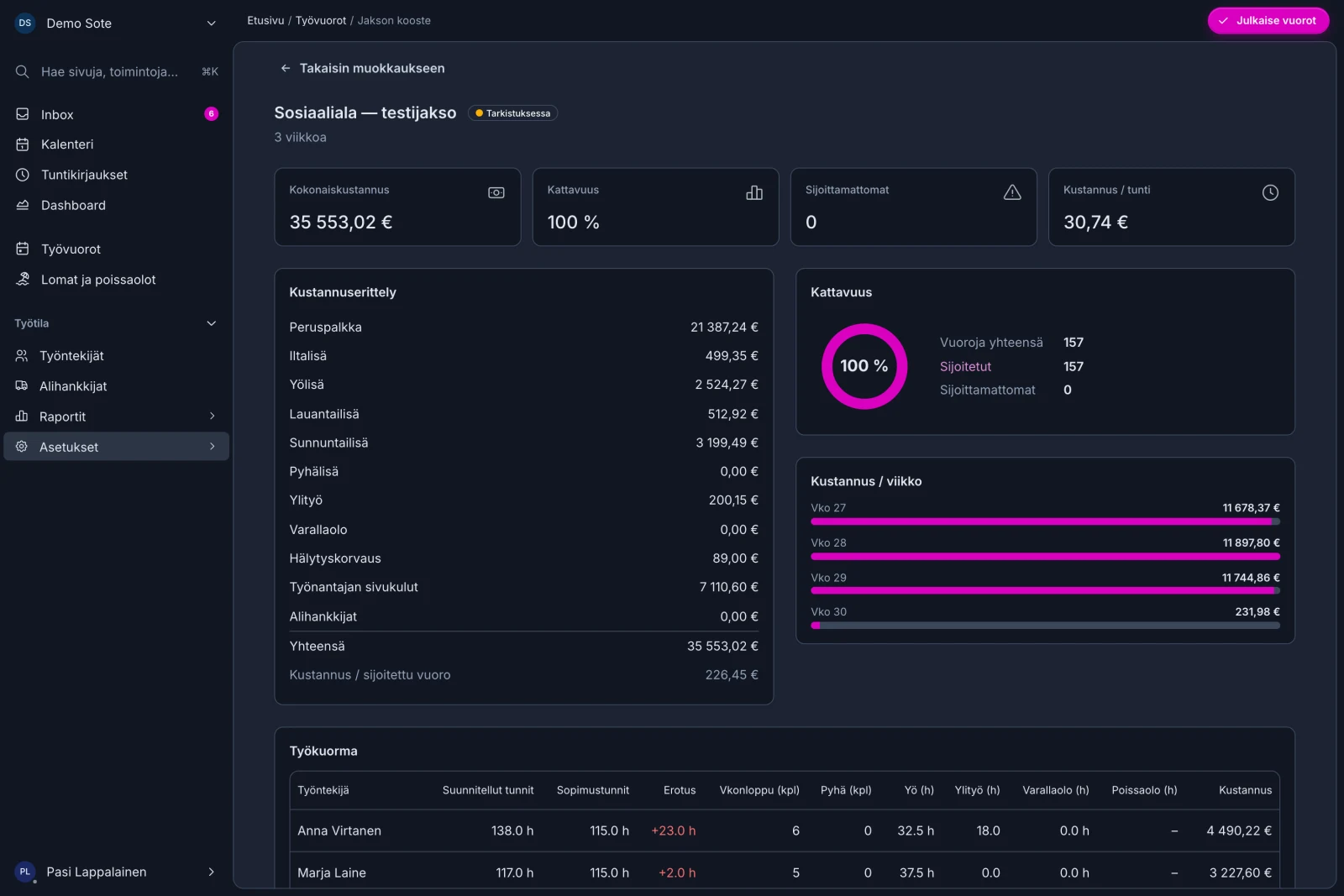
Smove checks rest periods and flags gaps under 11 hours, supports forward-rotating shift patterns and helps limit the number of consecutive night shifts. Employees can submit shift wishes, and the strain is visible to the planner while the roster is being built, not only afterwards.
Ready to start?
Shifts handled. You focus on people.
Try Smove free for 14 days. No credit card, no commitment.